
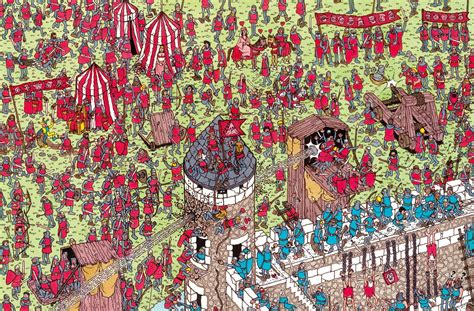
These Printabel Wheres Waldo activities are designed to turn focus into a playful, creative exercise. By combining careful visual search with creative thinking, they help sharpen attention, enhance processing speed, and spark imagination—all in printable formats you can use at home or in the classroom.
Key Points
- Enhances sustained attention through structured, goal-oriented search tasks.
- Balances challenge and accessibility with scalable difficulty and printable pages.
- Supports fine motor skills and precise marking through deliberate tracing or coloring.
- Promotes creativity by adding optional extensions like storytelling or color prompts.
- Easy to deploy anywhere, with minimal setup and low ongoing cost.
1. Printabel Waldo Scavenger Hunt
Print a Waldo scene and set a happiness-focused objective: locate Waldo and ten hidden items. Use a timer for a gentle time pressure, then switch roles so a student can hide items for peers to find. This activity builds visual scanning and sustained attention while keeping the mood light and fun.
2. Waldo Dash: Timed Search Challenge
Choose a page, set a short timer (2–5 minutes), and try to find Waldo and a handful of his friends before the clock runs out. The speed aspect trains quick decision-making and improves focus under mild pressure, with an optional scorecard for motivation.
3. Detail Detective: 15 Hidden Details
Create a list of 15 subtle details to spot in a Waldo page—glasses reflections, striped patterns, or background items. Readers check off found details as they go. This sharpens perceptual discrimination and careful observation, turning inspection into a rewarding puzzle.
4. Waldo Across Pages: Multi-Page Search
Print two related Waldo scenes and challenge players to locate Waldo in both pages within a single session. Transitioning between pages strengthens working memory and cognitive flexibility while preserving a calm, focused pace.
5. Color and Highlight: Color-Change Hunt
Ask players to color Waldo’s red stripes or specific objects found near Waldo. This combines visual search with motor engagement and color association, promoting planning and precise mark-making.
6. Shadow and Shape Waldo
Provide a page with Waldo silhouettes and ask learners to spot Waldo or outline his shape. This activity supports visual silhouette recognition and pattern matching, boosting concentration and spatial reasoning.
7. Waldo Storyboard: Create a Mini-Adventure
After finding Waldo, players sketch a quick storyboard or captioned panel about his next destination. This encourages creative thinking, narrative planning, and reflection on what was found, tying focus to imaginative output.
8. Texture and Detail Gallery
Print scenes with varied textures (grass, bricks, fabric). Participants locate Waldo and then describe or sketch three distinct textures nearby. This fosters descriptive skills, sensory awareness, and careful scanning.
9. Waldo Grid Hunt: Locate in a Grid
Print a Waldo scene laid out on a grid and instruct players to mark Waldo’s coordinates. This introduces a light grid-based reasoning task, supporting attention to spatial relationships and methodical searching.
10. Waldo Create-Your-Own Page
Give learners a blank Waldo-themed template and have them design a new scene featuring Waldo and friends. Printing a starter page and letting them brainstorm locations builds agency, creativity, and motivation to engage with visual search tasks.
What age group are these Printabel Wheres Waldo activities best suited for?
+They scale well from early elementary to teens. You can adjust difficulty by choosing simpler scenes for younger learners or adding time constraints and detail-heavy pages for older kids and adults.
How can I adapt these activities for a group setting?
+Assign roles (finder, timer, note-taker) to distribute activity load, use shared printables, and rotate pages so everyone participates. Short rounds with clean transitions keep the group engaged.
What supplies do I need beyond prints?
+Basic supplies include a printer, plain pencils or colored pencils, scissors (optional for cut-out challenges), and a timer. A simple answer key helps with quick feedback after each round.
Can these activities support creativity alongside focus?
+Yes. Several prompts invite storytelling, drawing, or design tasks that extend the focus practice into imaginative output, making the experience richer and more engaging.